
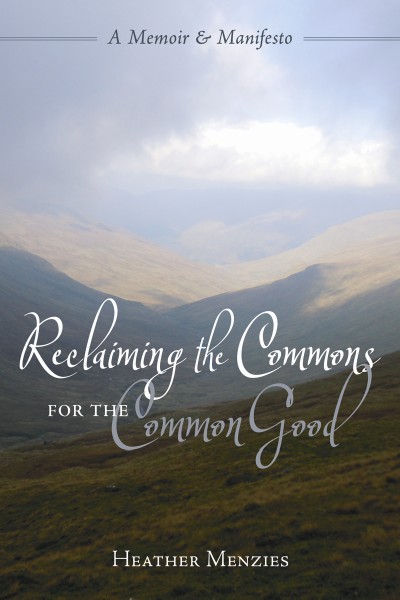
Reclaiming the Commons for the Common Good

A Memoir & Manifesto

Commoning was a way of life for most of our ancestors. In Reclaiming the Commons for the Common Good, author Heather Menzies journeys to her roots in the Scottish Highlands, where her family lived in direct relation with the land since before recorded time.

Beginning with an intimate account of unearthing the heritage of the commons and the real tragedy of its loss, Menzies offers a detailed description of the self-organizing, self-governing and self-informing principles of this nearly forgotten way of life, including its spiritual practices and traditions. She then identifies pivotal commons practices that could be usefully revived today. A final ‘manifesto’ section pulls these facets together into a unified vision for reclaiming the commons, drawing a number of current popular initiatives into the commons and commoning frame-such as local food security, permaculture and the Occupy Movement.

An engaging memoir of personal and political discovery, Reclaiming the Commons for the Common Good combines moving reflections on our common heritage with a contemporary call to action, individually and collectively, locally and globally. Readers will be inspired by the book’s vision of reviving the commons ethos of empathy and mutual respect, and energized by her practical suggestions for connecting people and place for the common good.


Contributors

Heather Menzies

Heather Menzies is an award-winning writer and scholar and the author of nine books, including Whose Brave New World? and No Time. She has been awarded an honourary doctorate and the Order of Canada for her "contributions to public discourse." A mother and grandmother, a gardener and social-justice activist, Heather regularly contributes to journals and newspapers, and is in high demand as a speaker, offering a thoughtful critique of our disintegrating social fabric.
Chapter Contributors Pages Year Price
This chapter examines the author’s search for their roots in Scotland and how that search helped her connect with the First Nations struggle in North America.
7 $0.70
This chapter covers the author’s struggle of feeling lost and directionless, trying to find meaning and focus in searching for answers. It also talks about her decision to search for her …
4 $0.40
The author’s trip to Scotland, to her family’s ancestral roots in Tulliro.
4 $0.40
The author researches her heritage, leading to understanding as she treads the paths of her ancestors.
6 $0.60
Tending to the garden provides insight and new connections for the author.
5 $0.50
Explaining the ancient property laws of Scottish clans as they exised until the encroachment of kings.
6 $0.60
Looking at the introduction of Christianity to the Picts in Scotland, comparing it to the ethos of Native American religions.
11 $1.10
Exploring the dissolution of communal farms in Scotland and the pitfalls of rigid British feudal farmlands.
8 $0.80
The institution of feudal land, the concept of private property, and the disappearance of common land.
4 $0.40
The cost of the Scottish Clearances through forced emmigration and the abolition of Scottish commons.
7 $0.70
The disappearance of commons across the globe pushes the author to act on her expriences in Scotland, throwing her support behind the Idle No More movement.
9 $0.90
The Gabriola commons is a community and community centre that exists only through the collective actions of the people. A loss of capacity building and a lot of healing will be required if such a …
10 $1.00
"The more I’m securely connected to myself. The more I can risk connecting with others, getting involved in the Gabriola Commons, committing to endless meetings of the Covenant Team. …
6 $0.60
At its simplist, a commons is a habitat of interrelationships bound by mutuality: mutual obligation and mutual sef-interest and also, hopefully, affinity.
8 $0.80
The essential thing in people, especially kids, becoming ecoliterate is creating opportunities for ongoing participation in particular local habitats.
10 $1.00
The author suggests that learning and knowledge flow from attentive participation, with the senses wide open, and possibly the heart as well.
8 $0.80
Staying implicated in the common good and the good of the commons and community is a big part of reclaiming the commons, though not all of it.
12 $1.20
Patterning won’t emerge by just wishing or waiting for its emergence. It requires action, behaviour-changing, consciousness-changing action at every level from the personal to the …
10 $1.00
If we want to come home to the Earth, reviving our sense of connection to it, we must first come home to ourselves, healing our relationship with ourselves, and those around us.
9 $0.90
Reclaiming the commons begins by claiming your place within it–and in the process, awakening to a different understanding of yourself, even a different understanding of what’s real …
8 $0.80
Alliances are being formed, facilitating scale-up. New food assembly and distribution hubs are being created for farmers producing on a larger scale but still using more responsible …
10 $1.00
Common cause projects can at the same time tackle the global and local activist divide, bringing members of national and international groups together with local, grounded activists.
14 $1.40
Claiming our agency as participants in situations, communities, and habitats who become responsibly knowledgeable about them is a huge first step towards reclaiming the commons.
11 $1.10
The author suggests that restoring governance for a common good that includes the well-being of the whole planet will require revitalizing democracy at every level.
12 $1.20
Becoming attuned to others in the shared habitats of life on Earth: it’s that simple and that mysterious.
8 $0.80
There is a wealth of precedent out there to inspire a commoning movement, though not necessarily yet as scaled up, more polycentric levels.
12 $1.20
4 $0.40