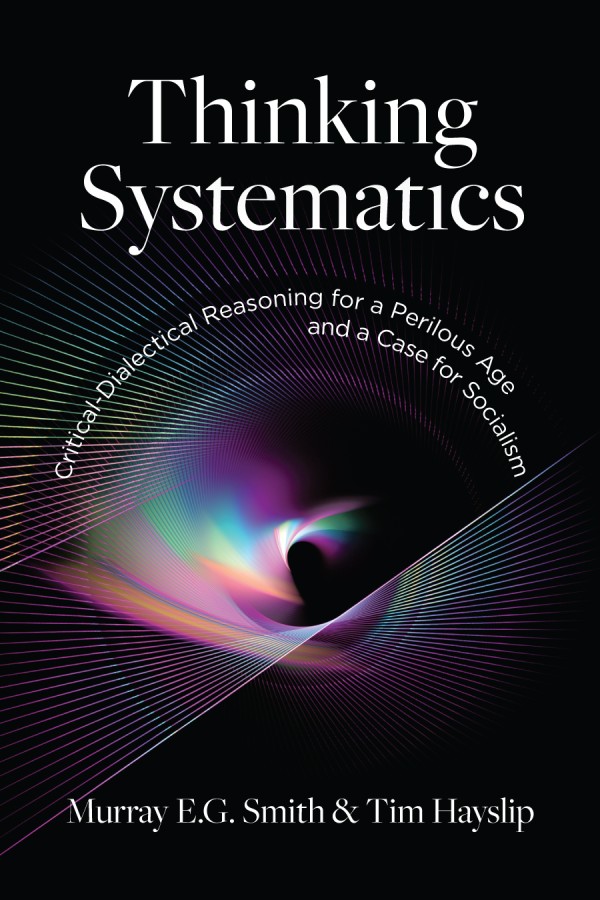
Thinking Systematics

Critical-Dialectical Reasoning for a Perilous Age and a Case for Socialism

New!

Thinking Systematics (TSS) is conceived as a “toolkit for the mind” — designed to improve how we think about the world, analyze information and pursue our goals. Smith and Hayslip make a compelling argument that individual thinking and collective decision making are being systematically constrained within limits imposed by outmoded forms of cognition and the determination of privileged elites to perpetuate an unsustainable status quo. The dialectical reasoning advocated in this wide-ranging book aims to overcome those limits and to allow a much more profound understanding of the human condition in the 21st century.

Contributors

Murray E.G. Smith

Murray E.G. Smith is professor emeritus in sociology at Brock University, with interests in social theory, political economy, health and illness, social movements, philosophy and dialectical methodology. His previous books include Twilight Capitalism and Invisible Leviathan.

Tim Hayslip

Tim Hayslip is a PhD student in sociology at York University. His research focuses on the intersection of the sociology of knowledge and economic sociology, seeking to explain the popularity of the Austrian School of Economics and its remedies for economic malaise: higher interest rates, less market regulation and allowing the bankruptcies of “zombie companies.”

Chapter Contributors Pages Year Price
In this chapter, Smith and Hayslip introduce their work and trace a path from formal logic and dialectics, through Western philosophy and social thought, to Marxism.
; 5 $0.50
In this chapter, Smith and Hayslip examine critical thinking, societal structure, and the slow decay of culture under media-driven conditioning.
; 11 $1.10
In this chapter, Smith and Hayslip trace widening wealth inequality, the erosion of liberal democracy, human-caused environmental damage, and escalating tensions in international relations.
; 10 $1.00
In this chapter, Smith and Hayslip examine how human potential is shaped by societal structures, tracing Darwin’s view that empathy extends beyond small tribes and Keynes and Marx’s …
; 4 $0.40
In this chapter, Smith and Hayslip examine the persistent gap between humanity’s problem-solving capacity and widespread suffering from hunger, preventable disease, and violent conflict.
; 2 $0.20
In this chapter, Smith and Hayslip discuss how conventional modes of reasoning are inadequate to the crises facing humanity in the early twenty-first century.
; 25 $2.50
In this chapter, Smith and Hayslip trace the evolution of dialectical reason from ancient Greek philosophy through Hegel’s 1830 Logic to the materialist dialectic of Marx and Engels in the …
; 9 $0.90
In this chapter, Smith and Hayslip introduce ‘Thinking Systematics’, a framework for applying dialectical logic drawn from Hegel, Marx, and Spinoza to practical problems.
; 25 $2.50
In this chapter, Smith and Hayslip examine the global environmental crisis from the industrial era to the mid-twenty-first century.
; 31 $3.10
In this chapter, Smith and Hayslip trace the evolution of Western philosophy from ancient Greece through the modern era.
; 40 $4.00
In this chapter, Smith and Hayslip examine the relationship between faith, critical reason, and moral life.
; 33 $3.30
In this chapter, Smith and Hayslip trace the philosophical concept of the ideal from Plato’s ancient inquiries through the Enlightenment to Marx’s materialist dialectic.
; 32 $3.20
In this chapter, Smith and Hayslip present a Marxist philosophical critique of dualistic thinking.
; 26 $2.60
In this chapter, Smith and Hayslip explore the intellectual foundations of Marxist socialism.
; 7 $0.70
In this chapter, Smith and Hayslip break down the various arguments in favour of socialism.
; 46 $4.60
In this chapter, Smith and Hayslip present a framework for rigorous, truth-oriented thinking as a corrective to relativism and post-truth culture.
; 46 $4.60