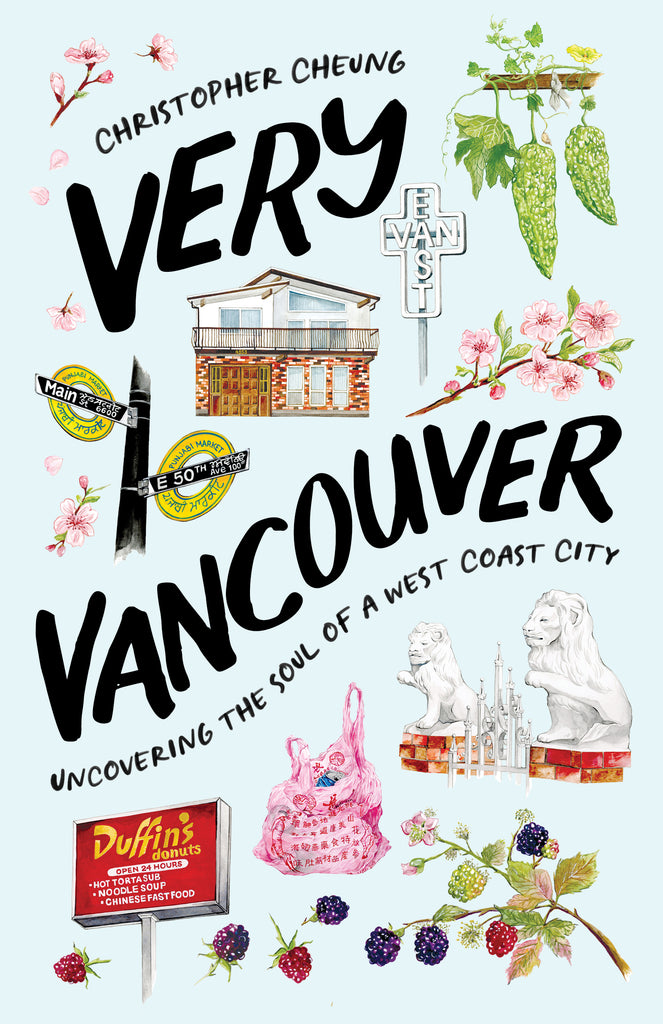
Very Vancouver

Uncovering the Soul of a West Coast City

New!

Vancouver journalist Christopher Cheung has spent most of his career chasing the stories that no one else was covering, taking readers beneath the surface of the “city of glass” to expose the beating, multicultural heart of a place that has too easily been characterized by multimillion-dollar condos and yoga pants. In 15 deeply human and well-researched stories, Very Vancouver tours the city to reveal how families, businesses, and individuals are just trying to make a home in this beautiful, and challenging, place of plurality. There are the families who were the first to mass-produce Canadian tofu and put beef balls in the earliest bowls of east-side phở. There is the diligent population of binners who scavenge alleyways for refundable cans and bottles. There is the roller-coaster story of how migration has shaped the kaleidoscopic menu — with bear claws, bánh mì, and tamales — of the legendary late-night Duffin’s Donuts. And, of course, there is the mysterious Baklava Man, who sold his treats on downtown streets after a career as an outspoken politician in Syria led to his exile. Very Vancouver is a tribute to the city’s diasporas and examines the inequalities and fractured histories that mark every backyard vegetable garden and ubiquitous Vancouver Special, the boxy and derided design that housed newcomers. Vancouver is renowned for its natural beauty, but it’s also a place built on a foundation of migration, colonization, the working poor, and families who woke up every morning hoping for better.

Contributors

Christopher Cheung

Christopher Cheung is the author of Under the White Gaze: Solving the Problem of Race and Representation in Canadian Journalism. He has worked as a reporter at The Tyee, Metro, and the Vancouver Courier and has received two Webster Awards, BC’s top journalism prize. He was born and raised in Vancouver, where he still lives.

Chapter Contributors Pages Year Price
In this chapter, Cheung examines the enduring east–west divide along Ontario Street, contrasting the working-class east with the affluent west in Vancouver, BC.
5 $0.50
In this chapter, Cheung explains how he has spent most of his career as a journalist chasing the stories that no one else was covering in Vancouver.
15 $1.50
In this chapter, Cheung traces his childhood on the east side of Vancouver, focusing on his father’s pharmacy in a neighbourhood shaped by post-war European and post-1967 Asian immigration.
3 $0.30
In this chapter, Cheung discusses the Himalayan blackberry’s invasion of Vancouver’s landscapes since its introduction by horticulturist Luther Burbank around 1885.
12 $1.20
In this chapter, Cheung discusses the gifts his piano teacher would receive from different students, and how they carried stories of migration, holiday tradition, and belonging.
3 $0.30
In this chapter, Cheung discusses Liang Po Po, a seventy-year-old woman in Chinatown who earns a modest income collecting empty containers at recycling depots.
17 $1.70
In this chapter, Cheung discusses a twenty-one-year-old UBC graduate who lands a summer newsroom job at the Vancouver Courier under editor Barry Link.
3 $0.30
In this chapter, Cheung traces the life of Yip Sang, a Chinese immigrant who built a vast trading empire in Vancouver from 1888 until his death in 1927.
21 $2.10
In this chapter, Cheung discusses his first days at the Courier, a community biweekly newspaper in Vancouver.
4 $0.40
In this chapter, Cheung discusses the journey of Mohamad-Mamon Alhomsi, a former Syrian parliamentarian who sold handmade baklava at Vancouver transit stations from 2017 to 2018.
23 $2.30
In this chapter, Cheung discusses Bill Davies, known as the Mayor of West 18th in Vancouver, and the community he built with his wife Shirley on the 3800 block.
3 $0.30
In this chapter, Cheung traces the history of tofu production in Vancouver, focusing on the Sunrise Soya Foods factory on Powell Street.
13 $1.30
In this chapter, Cheung discusses a summer in Vancouver pitching story ideas rooted in the city’s deep multicultural connections to the wider world.
2 $0.20
In this chapter, Cheung discusses the Vancouver Special, a distinctive style of two-storey home.
19 $1.90
In this chapter, Cheung discusses his experience visiting his Chinese grandparents.
2 $0.20
In this chapter, Cheung discusses the vegetable gardens of Vancouver’s east side, where Cantonese families have cultivated choy, melons, and gourds on trellises for generations.
16 $1.60
In this chapter, Cheung reflects on his columns for Vancouver’s community papers, the Courier and Metro, during the 2010s.
3 $0.30
In this chapter, Cheung discusses the lives of Tony Chhuon and Paula Sim, Cambodian refugees who fled the Khmer Rouge in 1975 and went on to build a multicultural donut empire in Vancouver.
15 $1.50
In this chapter, Cheung discusses his internship at The Tyee, a progressive online news magazine founded in 2003 in Vancouver.
3 $0.30
In this chapter, Cheung traces how Vancouver’s street and building names are representative of colonial violence.
16 $1.60
In this chapter, Cheung follows Claire, a Punjabi machinist who settled in Coventry, England, in 1962, where waves of Indian immigrants built a vibrant community of shops and cultural spaces.
1 $0.10
In this chapter, Cheung traces the founding and evolution of Punjabi Market in Vancouver’s south slope, beginning with Claire’s fabric store in 1970.
15 $1.50
In this chapter, Cheung traces his place within a tight-knit media community known for watchdog reporting.
4 $0.40
In this chapter, Cheung traces the life of Châu, a Vietnamese refugee who, from a small kitchen in Vancouver’s Strathcona neighbourhood, built Kim Châu Deli around her hand- …
17 $1.70
In this chapter, Cheung examines the collapse of Vancouver’s local journalism, from Postmedia’s 2015 buyouts of the Sun and the Province to the 2020 closure of the Courier.
4 $0.40
In this chapter, Cheung discusses Kingsgate Mall, a small enclosed shopping centre at the intersection of Broadway and Kingsway in Vancouver’s Mount Pleasant neighbourhood.
15 $1.50
In this chapter, Cheung traces how Vancouver mirrors the small, tightly knit village communities of rural China.
2 $0.20
In this chapter, Cheung examines the threatened Filipino community on Joyce Street in east Vancouver, where small businesses have anchored working-class life since the 1990s.
14 $1.40
In this chapter, Cheung examines the tension between journalistic ethics and the human impulse to share food.
3 $0.30
In this chapter, Cheung discusses a 2024 fire at the Keefer Rooms, a 1912 single-room occupancy building in Vancouver’s Downtown Eastside, which displaced thirty-nine households and exposed …
19 $1.90
In this chapter, Cheung explores the Victoria-Fraserview neighbourhood through its immigrant and working-class families.
4 $0.40
This "chapter" includes references.
18 $1.80