
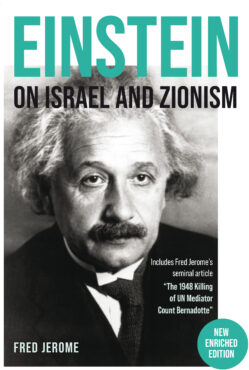
Einstein on Israel and Zionism

Albert Einstein said his “life is divided between equations and politics.” Yet his views on Israel and Zionism were concealed and distorted for decades. Einstein on Israel and Zionism corrects the widely accepted story that Einstein was a major supporter and “champion” of the State of Israel––a fabrication told and retold primarily in the mainstream media.

Einstein was a secular Jew, but he had mixed feelings about Zionism. Though he supported the goal of a Jewish “homeland” within Palestine, he never wavered from arguing forcefully for equal rights and equal power for the Arabs, whom he called “kinfolk” of the Jews. His nationalism had no room for aggressiveness or chauvinism. For him, the domination of Jew over Arab in Palestine, and the perpetuation of a state of mutual hostility between the two peoples, would mean the failure of Zionism.

Drawing exhaustively from letters and statements, some of which had never before appeared in English, Fred Jerome presents and contextualizes Einstein’s writings on Palestine from 1919 until his death in 1955.

Had the warnings of one of the twentieth century’s greatest thinkers been heeded, generations of death and destruction in Palestine might have been avoided.

Contributors

Fred Jerome

Fred Jerome (1939-2020) was a journalist, science writer, activist, and author of several books including The Einstein File, The FBI’s Secret War on the World’s Most Famous Scientist (Baraka Books, 2018) and Einstein on Race and Racism. His investigative reports or op-ed pieces appeared in dozens of publications including Newsweek, The New York Times and The Link. As a reporter in the South during the early 1960s, he covered the explosive civil rights movement. He also taught at Columbia Journalism School, NYU and numerous other New York-area Universities.


Chapter Contributors Pages Year Price
This note, written by translator Michael Schiffmann in Heidelberg in December 2008, reflects on rendering Albert Einstein’s writings about Israel and Palestine into English.
4 $0.40
In this chapter, Jerome examines Albert Einstein’s relationship with Israel and Zionism.
4 $0.40
In this chapter, Jerome traces Albert Einstein’s evolving relationship with Jewish identity and Zionism against the broader history of the movement from the late nineteenth into the early …
17 $1.70
In this chapter, Jerome examines Albert Einstein’s evolving relationship with Zionism and Jewish identity from 1919 to 1929.
28 $2.80
In this chapter, Jerome traces the 1929 to 1939 crisis in British Mandate Palestine, and Albert Einstein’s unwavering advocacy for Jewish-Arab reconciliation.
60 $6.00
In this chapter, Jerome traces the political and social developments in Palestine between 1939 and 1945, from the British White Paper’s immigration restrictions to the Biltmore Conference …
11 $1.10
In this chapter, Jerome explores Albert Einstein’s opposition to a Jewish state during the years of 1945 to 1948.
35 $3.50
In this chapter, Jerome examines Einstein’s final years, 1948 to 1955, centring on his complex relationship with the newly established State of Israel and his opposition to the nuclear arms race.
26 $2.60
In this chapter, Jerome examines how the myth of Einstein as a champion of Israel was constructed in U.S. media after his death in 1955.
6 $0.60
This chapter is a brief reflection on how we mythologize public figures after they die, and project our own biases onto them.
1 $0.10
This appendix examines two letters published under Albert Einstein’s name between 1929 and 1947 that archival evidence suggests he did not write. Both address the Jewish reconstruction of …
14 $1.40
This appendix profiles the correspondents of Albert Einstein, discussing physics, law, architecture, politics, and journalism.
12 $1.20
In this appendix, Jerome examines the 1948 assassination of Swedish Count Folke Bernadotte, the United Nations’ first mediator in Palestine.
19 $1.90
This "chapter" is a bibliography.
32 $3.20