
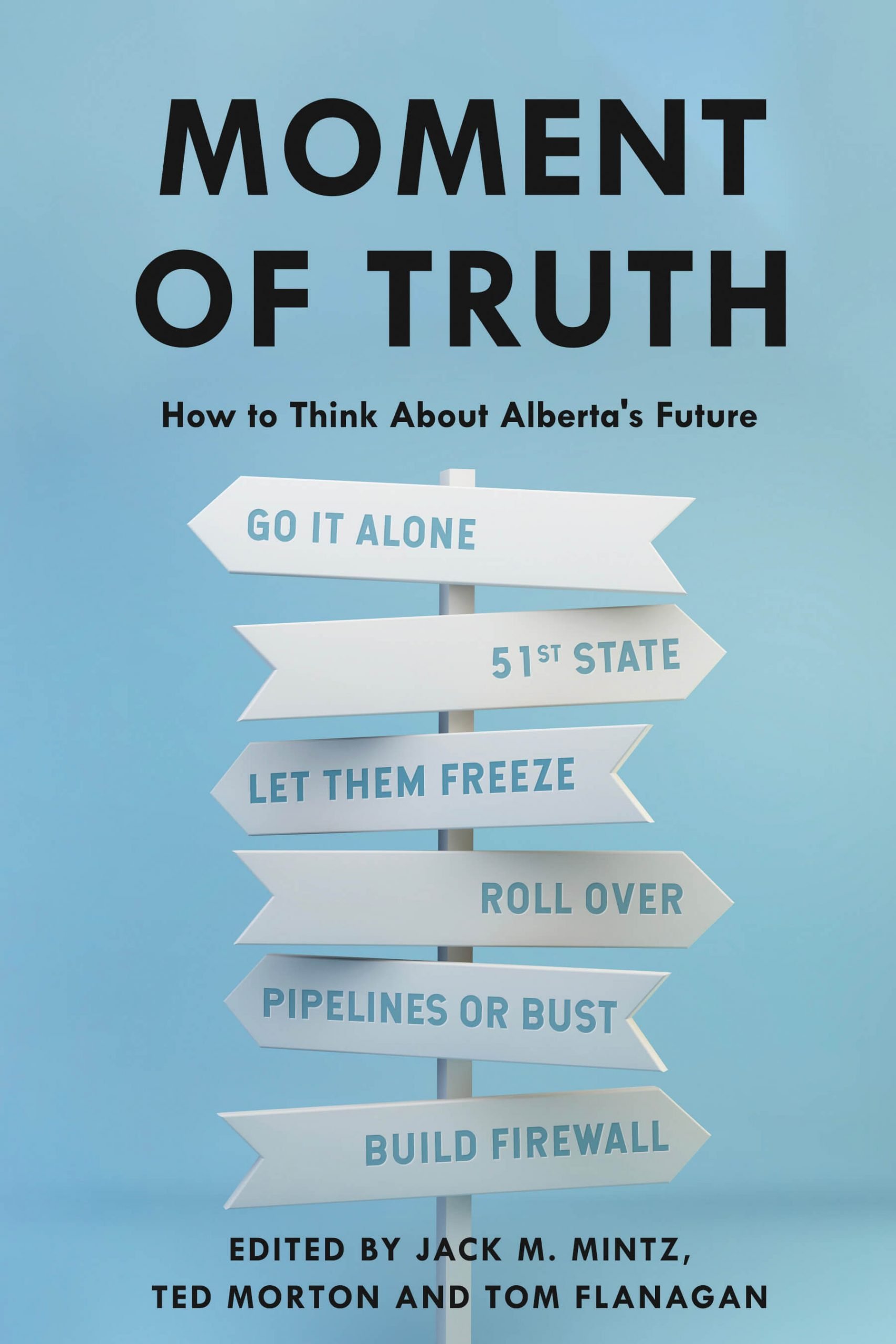
Moment of Truth

How to Think About Alberta's Future

Alberta is at a crossroads. Its situation in Canadian confederation is unfair. It is unequal. So…what comes next? What westerners ultimately need to decide if the best response to that unfairness and inequality is to leave Canada and the great northwest to carve out a smaller but separate country. Or do we simply need to clearly define what would constitute a genuine Fair Deal, not just for Alberta, but for all Canadians who share our values and perspectives on what this country should be? Moment of Truth is a series of provocative, thoughtful, and timely essays, curated by three of Canada’s most respected and original political thinkers, debating whether we should pursue the little western path of yet another division of the northwest, this time via secession, or march along the big western path aimed at nothing less than fairness for ourselves – and everyone else – through a re-confederation.

Contributors

Jack M. Mintz

Ted Morton, a former cabinet minister in the Alberta government, is an Executive Fellow at the School of Public Policy and Professor Emeritus of Political Science, University of Calgary. Tom Flanagan, a former advisor to Prime Minister Stephen Harper, is Professor Emeritus of Political Science and Distinguished Fellow at the School of Public Policy at the University of Calgary. Jack M. Mintz is the President’s Fellow of the School of Public Policy at the University of Calgary.


Chapter Contributors Pages Year Price
This preface examines the cultural and political tensions between Western Canada and the rest of the country, tracing grievances from the Crow rate through the National Energy Policy.
7 $0.70
In this chapter, Manning examines whether Western Canadians should pursue secession or re-confederation on fairer terms.
24 $2.40
In this chapter, Morton examines Alberta’s deteriorating position within Canadian confederation from 1980 to the early 2020s.
24 $2.40
In this chapter, Flanagan traces Alberta’s roughly 150-year struggle, from the 1869 purchase of Rupert’s Land to the 2020s climate policies, to safeguard its natural resources within …
25 $2.50
In this chapter, Mintz examines why small, wealthy regions sometimes seek separation from larger federations, drawing on cases from Australia, Belgium, Czechoslovakia, Singapore, Norway, …
23 $2.30
In this chapter, Savoie examines how Canada’s political institutions, inherited from Britain in 1867, have remained spatially blind to the nation’s vast regional divisions.
21 $2.10
In this chapter, Mansell traces Alberta’s fiscal relationship with the federal government from 1961 to 2018.
26 $2.60
In this chapter, Emery and Fellows examine Alberta’s economic role within Canadian confederation, from the 1947 Leduc oil discovery through the 2020s.
22 $2.20
In this chapter, Burney and Osler Hampson examine Alberta’s economic vulnerability from the late 1990s through 2020, outlining three strategic trade options for the province.
25 $2.50
In this chapter, Ogle examines the economic, political, and regulatory challenges facing Alberta’s oil and gas sector, proposing bold infrastructure solutions including a Canadian Northern …
23 $2.30
In this chapter, Albert traces the legal pathway Alberta would follow to secede from Canada, anchored in the 1998 Quebec Secession Reference and the 2000 Clarity Act.
26 $2.60
In this chapter, Cooper examines the deepening tensions that have grown between western Canada and what Cooper terms Laurentian Canada.
22 $2.20
In this chapter, Bercuson outlines a security policy for an independent Alberta, proposing a new Ministry of Public Safety to oversee a minimal military, cyber defence, and infrastructure protection.
16 $1.60
This conclusion examines how Canada’s electoral system and fiscal policies have structurally disadvantaged Alberta and the Western provinces since 1961.
28 $2.80