
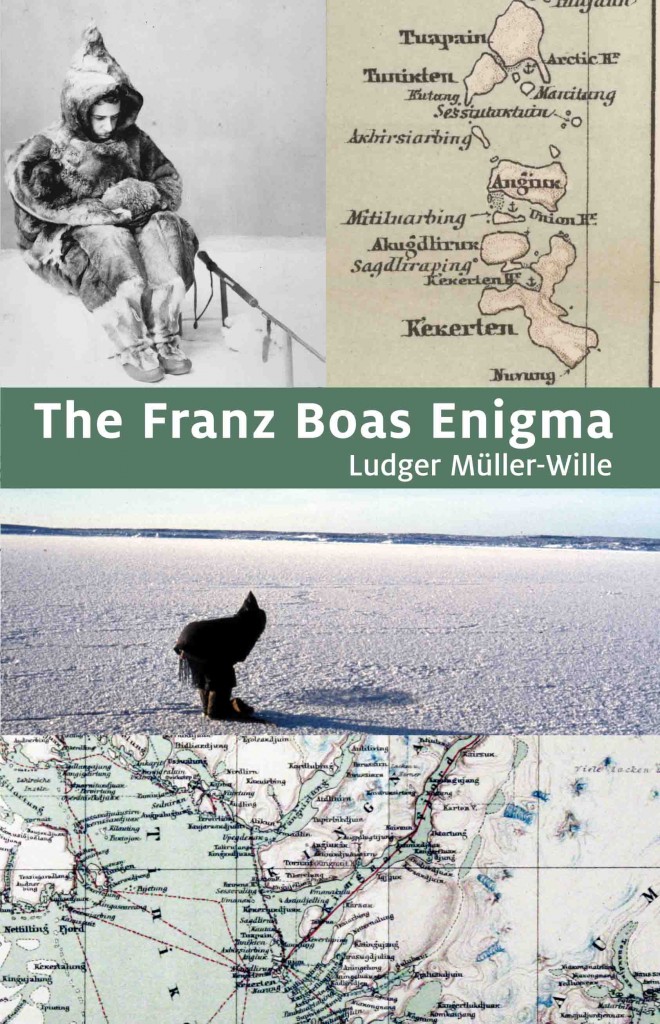
The Franz Boas Enigma

Inuit, Arctic, and Sciences

“… Franz Boas has remained an enigma, so misunderstood as a person and so often misrepresented as an anthropologist.” William S. Willis, Jr.

How did Franz Boas become the central founder of anthropology and a driving force promoting science in public life in North America? To answer this question, linguistic and cultural barriers must be overcome to grasp the importance of Boas’s personal background and academic achievements as a German Jew. Müller-Wille asserts that the key is in his publications in German on Inuit and the Arctic as related to environmental, geographical, and ethnological questions. These writings have remained largely unknown and neglected in the English-speaking world, yet they represent his emerging scientific interpretations of Inuit culture and the Arctic. They also provide insight into the crucial period of Inuit history 130 years ago at a time of European and North American colonial expansion into their homeland.

“And what I want, what I will live and die for, is equal rights for all, equal opportunities to work and strive for poor and rich! Don’t you think that when one has done even a little toward this, this is more than the whole of science together?” Franz Boas, Baffin Land, 22 January 1884

Foreword by Rosemary Lévy Zumwalt

Please Note: A collection can contain up to 30% of the chapters from this title

Contributors

Ludger Müller-Wille

Ludger Müller-Wille is a Montreal anthropologist and geographer who taught at McGill University for thirty years. Author and editor of books and articles on Franz Boas, he has conducted extensive research in the Arctic and Subarctic among Sámi and Finns in Finland and Inuit, Dene, and Naskapi in Canada. Ludger Müller-Wille is also author of Inuit and Whalers on Baffin Island through German Eyes, Wilhelm Weike’s Arctic Journal and Letters (1883-84) published by Baraka Books in 2012.
Chapter Contributors Pages Year Price
5 $0.50
On Franz Boas, his research, and pivotal role in the history of science and anthropology. His publications provide us two-fold insights: an understanding of the scientific stimuli the young Boas …
9 $0.90
Chapter 1 discusses Franz Boas’ life and research/various publications and their importance as well as explores his interests, academic directions, and influences. Chapter 2 explores …
20 $2.00
Chapter 3 looks at the leadup to Boas’ trip to the Arctic, exploring how he organized and funded this trip. It also looks at the articles he wrote before his trip and their impact. Chapter …
26 $2.60
Chapter 5 looks at the aftermath of his sojourn with the Inuit and whalers, as he travelled between the USA and Europe, until his immigration to the United States. Chapter 6 discusses Boas’ …
10 $1.00
Chapter 7 covers the period of Boas’ life after he returned to Germany, detailing his feelings, travels, research and lectures. Chapter 8 starts as Boas is finishing his influential book …
16 $1.60
Chapter 9 begins after the publication of Baffin-Land, discussing its author’s enthusiasm, reception of the book, its structure/contents (chapter by chapter). It also comments on his …
21 $2.10
Chapter 11 details how Boas continued the study Inuit language, tales, and beliefs and continued to publish studies and give lectures. Chapter 12 looks at the character of Franz Boas and his …
17 $1.70