
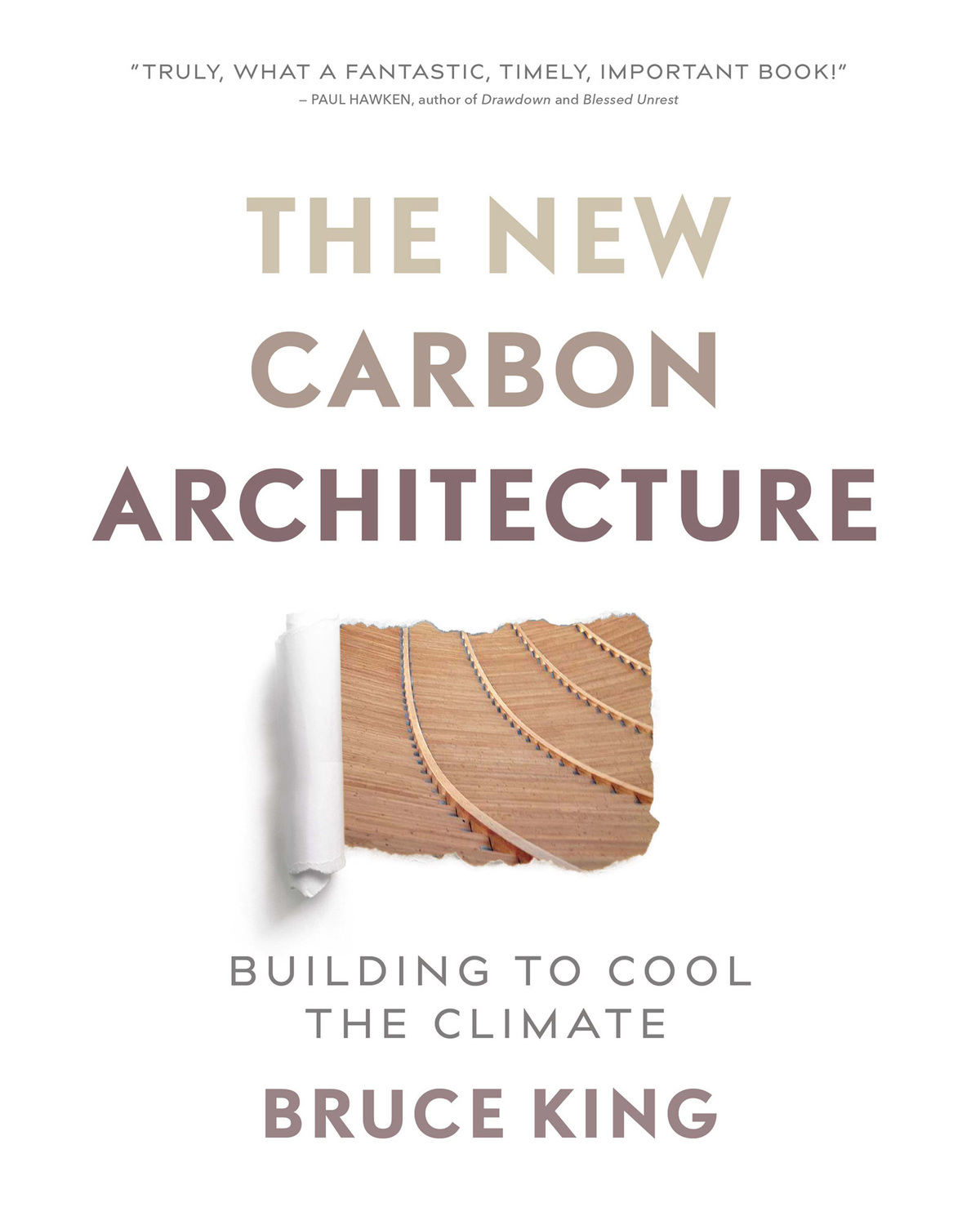
The New Carbon Architecture

Buiding to Cool the Climate

"Green buildings" that slash energy use and carbon emissions are all the rage, but they aren’t enough. The hidden culprit is embodied carbon — the carbon emitted when materials are mined, manufactured, and transported — comprising some 10% of global emissions. With the built environment doubling by 2030, buildings are a carbon juggernaut threatening to overwhelm the climate.

It doesn’t have to be this way.

Like never before in history, buildings can become part of the climate solution. With biomimicry and innovation, we can pull huge amounts of carbon out of the atmosphere and lock it up as walls, roofs, foundations, and insulation. We can literally make buildings out of the sky with a massive positive impact.

The New Carbon Architecture is a paradigm-shifting tour of the innovations in architecture and construction that are making this happen. Office towers built from advanced wood products; affordable, low-carbon concrete alternatives; plastic cleaned from the oceans and turned into building blocks. We can even grow insulation from mycelium.

A tour de force by the leaders in the field, The New Carbon Architecture will fire the imagination of architects, engineers, builders, policy makers, and everyone else captivated by the possibility of architecture to heal the climate and produce safer, healthier, and more beautiful buildings.


Contributors

Bruce King

Bruce King has been a structural engineer for 35 years, designing buildings of every size and type around the world. He is the Founder and Director of the Ecological Building Network (EBNet) www.ecobuildnetwork.org and the BuildWell conferences on green building materials. Bruce's decades of research into alternative building systems has led to building code changes in California and globally. He is the author of Buildings of Earth and Straw, Making Better Concrete, and the landmark Design of Straw Bale Buildings. Bruce lives in San Rafael, California.
Chapter Contributors Pages Year Price
This chapter highlights the role of buildings and building materials in meeting the goals of the Paris Climate Agreement.
9 $0.90
This chapter draws upon the results of Life Cycle Assessment studies to summarize what we know about whole building embodied carbon, and to highlight best opportunities for innovation and …
; ; 15 $1.50
In this chapter, the authors explore the difference between net-zero energy buildings and buildings with a low carbon footprint.
7 $0.70
This chapter explores the role of wood in building efficient and modern buildings.
; 16 $1.60
This chapter examines the use of "little trees," i.e., the stalks of straw that support seed crops.
; 12 $1.20
In this chapter, the authors turn to concrete, and suggest that the natural resources used to make it – lime, sand, and gravel – are in short supply. Moreover, the production of …
; 16 $1.60
In this chapter the authors explore some of contradictions in plastic, and explain and evaluate the potential paths and barriers to how plastic might actually redeem itself and prove that it has …
; ; 16 $1.60
This chapter considers the human health benefits derived from using natural building materials in construction. The aim here is to provide a current overview of the development, understanding, …
; ; 11 $1.10
In this chapter, the author seeks to answer the question: are there limits to how much increases in urban density — especially via vertical growth — will contribute to rather than …
11 $1.10
This chapter explores some of the technological trends that are accelerating green building.
9 $0.90
In the concluding chapter, King presents a variety of ways that people and organizations can influence the global construction market.
8 $0.80