
| Author(s) | |
|---|---|
| Publisher | |
| Publication Year |
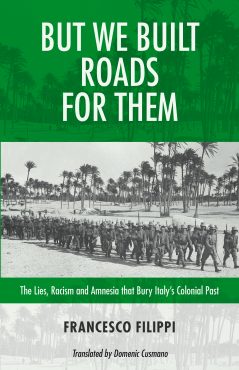
But We Built Roads for Them
The Lies, Racism and Amnesia that Bury Italy's Colonial Past
In the fiery political debates in and about Italy, silence reigns about the country’s colonial legacy. By reducing the European colonial sweep to Britain and France, Italy has effectively concealed an enduring phenomenon that lasted close to 80 years (1882 to 1960). It also blots out the history of the countries it colonized in Northeastern Africa. Italian colonial history began in 1882 with the acquisition of Assab Bay and came to a formal end only on July 1, 1960, when the Italian flag was lowered in Mogadishu, Somalia. It began well before Mussolini’s rise to power and lasted for many years thereafter. It involved both the Kingdom of Italy in the liberal period and the Republic of Italy after World War II. Francesco Filippi challenges the myth of Italians being “good” colonialists who simply built roads for Africans. Despite extensive historiography, the collective awareness of the nations conquered and the violence inflicted on them remains superficial, be it in Italy or internationally. He retraces Italy’s colonial history, focusing on how propaganda, literature and popular culture have warped our understanding of the past and thereby hampered our ability to deal with the present.
Contributors
Francesco Filippi
Francesco Filippi is a historian and educator who specializes in the relationship between memory and the present. He is co-founder of Deina, an association that organises trips of memory and training courses all over Italy. Filippi is the author of five books including the Italian bestseller Mussolini Also Did A Lot of Good (Baraka Books 2021). He lives in Trento, Italy.