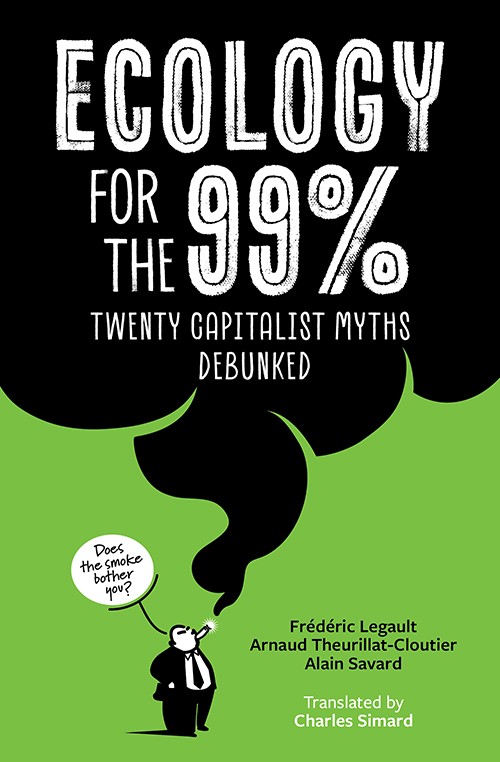
Ecology for the 99%

Twenty Capitalist Myths Debunked

Ecology for the 99% provides inspiration for building grassroots environmental movements through a lively discussion of the most persistent capitalist myths. It presents compelling evidence for why carbon market policies will fail, why a capitalist economy cannot be based on renewable energy sources, and why we should be protesting against overproduction, not overconsumption.

Contributors

Frédéric Legault

Frédéric Legault is a teacher and has a PhD in sociology about post-capitalist economics.

Arnaud Theurillat-Cloutier

Arnaud Theurillat-Cloutier is a philosophy teacher, doctoral candidate in sociology and author of Printemps de force.

Alain Savard

Alain Savard is an organiser and negotiators for labor unions in the food processing industry. He also has a PhD in political science (York University) on the theories of power and social change.

Clément de Gaulejac

Artist, author, and illustrator, Clément de Gaulejac has lived in Montreal since the early 2000s. His most recent exhibition is entitled Les Maitres du monde sont des gens (Galerie UQO, 2019; Écart, 2021; Plein sud, 2022; Musée régional de Rimouski, 2023). He is also the creator of the fountain called Bottes de pluie, installed in front of the Maisonneuve Library in Montreal. With Le Quartanier editions, he has published Les artistes (2017), Grande école (2012) as well as Le livre noir de l’art conceptuel (2011).

Charles Simard

Charles Simard is a Québécois editor and translator from Montréal, also known as Tiohtià:ke and Mooniyaang. He works as poetry, fiction, and non-fiction editor for Talonbooks in Vancouver on Coast Salish Territory. His published work includes the essay Littérature, analyse et forme: Herbert, Tolkien, Borges, Eco (EUE, 2010) and a number of translations for Orca Book Publishers, including Elise Gravel’s The Wrench and Myriam Daguzan Bernier’s dictionary of sexuality, Naked. He holds a Ph.D. and M.A. in comparative literature from Université de Montréal and was a postdoctoral fellow at the City University of New York’s Graduate Center.

Chapter Contributors Pages Year Price
This section introduces the economics of capitalism and the political strategies capable of overcoming it.
; ; ; ; 6 $0.60
This chapter explains capitalism as both an economic system and a form of social organization. It also explores how capitalism can be undemocratic and highlights the problems with capitalist companies.
; ; ; ; 8 $0.80
This chapter deconstructs the narrative that consumers should bear the weight of environmental guilt, explaining that wealthy people and the issue of production pollute more than consumers.
; ; ; ; 14 $1.40
This chapter reconsiders the dominant discourse which says that overpopulation is a primary contributor to the environmental crisis, discussing the harmful discourse resulting from this belief.
; ; ; ; 7 $0.70
This chapter examines the idea that the adoption of new technologies, such as geoengineering, will help mitigate the climate crisis. It explores how these proposed technologies risk further …
; ; ; ; 12 $1.20
This chapter interrogates the belief that economic growth can solve social and ecological problems, advocating for a decrease in production and degrowth policies.
; ; ; ; 10 $1.00
This chapter considers the harm that comes from stigmatizing the pollution of countries in the global South, discussing the interdependent relationships that connects Western countries to the South.
; ; ; ; 6 $0.60
This chapter describes the relationship between climate science and the political interest of major governments. It explains that while political leaders acknowledge the environmental crisis, …
; ; ; ; 8 $0.80
This chapter highlights how the climate crisis affects communities unequally, with some facing greater hardships and critiques the leaders responsible for these affects.
; ; ; ; 8 $0.80
This chapter challenges the idea that capitalism can grow without harming the environment, critiques the concept of "decoupling", and highlights how climate impacts are unevenly …
; ; ; ; 8 $0.80
This chapter discusses why capitalism is unlikely to abandon its dependence on fossil fuels and transition toward a renewable economic model.
; ; ; ; 11 $1.10
This chapter examines the limitations of carbon markets, highlighting their ineffectiveness in reducing emissions and highlighting how offset projects result in the infringement of Indigenous …
; ; ; ; 11 $1.10
This chapter critiques the "human nature" justification for capitalism by demonstrating the ways many societies have historically prioritized mutual aid and cooperation over individual …
; ; ; ; 8 $0.80
This chapter critiques the shortcomings of both contemporary capitalist economies and the Soviet model, and proposes democratic planning as an alternative framework for organizing the economy.
; ; ; ; 8 $0.80
This chapter interrogates the idea of the "free market," arguing that markets are actively shaped by dominant actors whose influence undermines innovation and contributes to systemic …
; ; ; ; 10 $1.00
This chapter outlines the practical organization of a democratically planned economy, highlighting how this model would be more environmentally responsible.
; ; ; ; 14 $1.40
This section discusses the need for enhanced democratic engagement in response to the climate crisis, emphasizing citizen empowerment.
; ; ; ; 8 $0.80
This section explains the importance of standing up to powerful political and economic groups by establishing a large-scale, environmentalist, popular power.
; ; ; ; 6 $0.60
This section highlights the need to build trust with people outside of the climate activist community, giving them time to adopt collective organizing practices and new ideals that support …
; ; ; ; 7 $0.70
This chapter explores the belief that prominent leaders drive social movements, arguing their influence is actually limited. It highlights the importance of strong, collective organization as …
; ; ; ; 5 $0.50
This chapter explains that electing environmentally conscious governments is not enough to enact climate action. It emphasizes the need for pre-election action to highlight the urgency and …
; ; ; ; 6 $0.60
This section argues that online activism is less effective than in-person engagement, since it mostly reaches those already aware of environmental issues and rarely persuades new audiences.
; ; ; ; 6 $0.60
This section outlines key strategies for addressing the climate crisis, showing how the tactics discussed throughout the book work together to advance coordinated action and climate justice.
; ; ; ; 24 $2.40
This appendix outlines a few simple principles to help get you started in activism.
; ; ; ; 6 $0.60
This section provides a glossary of technical terms used throughout the book.
; ; ; ; 5 $0.50