ISBN: 9781459407039

Categories:

 
View more details about this title on the publisher's website:

 
This title can be assigned for course purchase in eBook format through Campus eBookstore:

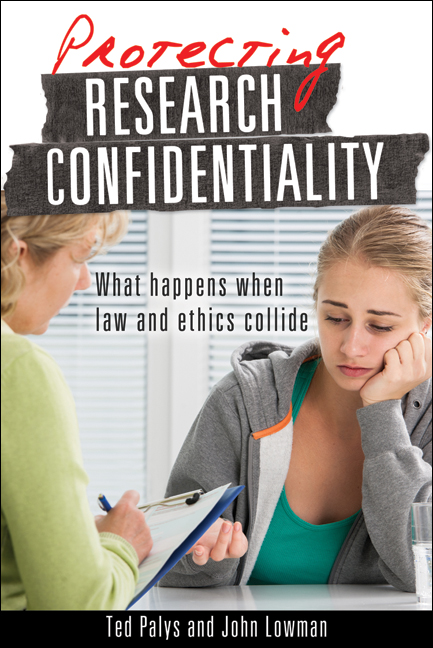
Protecting Research Confidentiality

What happens when law and ethics collide

Lawyers and their clients can talk in complete confidence, secure that the law protects what they say from being revealed to anyone. Priests can hear confessions with reasonable certainty that no court and no government will require them to speak of what they hear. But what about people who agree to help scientific researchers?

In 1994 a Simon Fraser graduate student faced the threat of being required by a court to disclose information he had obtained in his research on assisted suicide. He had given his research informants a promise of confidentiality. His dilemma, and his decision to refuse to identify his sources in the face of a threat of a court order, triggered a debate first at the university, then across Canada, on the ethics and law of research confidentiality. The examination of this case, and others in Canada and the United States, reveals the complex issues that arise when parties in criminal and civil trials seek to disclose confidential research information.

Many professionals — including journalists, lawyers, social workers, accountants, therapists, physicians, and police officers — depend on the expectation of confidentiality from people they deal with every day. This book provides the most comprehensive available discussion of confidentiality in research, a good understanding of what the law says today, and how it needs to be changed to ensure that the public interest is served.

Contributors

Ted Palys

TED PALYS and JOHN LOWMAN are both distinguished criminologists at Simon Fraser University. They have published widely on a variety of topics in their areas of research.

John Lowman

Ted Palys is a professor in the School of Criminology at Simon Fraser University. His areas of research and teaching include research methods and the sociology of knowledge; relations between Indigenous and non-Indigenous peoples in Canada and internationally; and the ethics and law of research confidentiality. He lives in Vancouver.

Chapter Contributors Pages Year Price
Provides an overivew of the topic of Research Confidentiality and the problem that academic researchers are not protected by law when it comes to assuring confidentiality to their participants, …
; 7 $0.70
Examines the threats to research confidentiality currently being faced by academics through outlining the purpose of the book as a whole, lawful threats to research confidentiality, What is at …
; 14 $1.40
Beginning of their analysis of Russell Ogden’s case regarding the subpoena he received on his research into assisted suicide, looks at his history with Simon Fraser University’s …
; 11 $1.10
Looks at Assisted Suicide in the News, The media and Ogden – their want of an expert and finding one in Ogden, Ogden and the SFU Administration
; 12 $1.20
An Introduction to understand evidentiary Priviledge, statutory priviledgem priviledge in common law and how it is decided on a case by case basis (wigmore criteria), looks at Ogden’s …
; 13 $1.30
Looks at institutional conflict of interest when it comes to academic research involving human participants, ethics under the law, and the limited confidentiality afforded to researchers
; 11 $1.10
Ogden resolves to hold the univeristy responsible for his legal bills as a breach of contractual obligation between himself and the university as he followed every policy and procedue outlined to …
; 8 $0.80
Looks at developing a Canadian research ethics code when involving human participants the tri-council working group drafted a code for those seeking to apply for funding from the three major …
; 8 $0.80
The SFU School of Criminology speaks out in support of Ogden, the colleagues on his side, and the call to review the university’s conduct regarding the Ogden subpoena
; 9 $0.90
Looks at the challenge to the institutional conflict of interest and the idea of limited confidentiality that was undertaken because of the Ogden case
; 13 $1.30
Looks at meeting with the SFU’s ethics committee in their conduct in the Ogden Case
; 12 $1.20
Looks at limited confidentiality and liability in terms of academic research using the SFU and Ogden as the main case study to anaylze the problem
; 10 $1.00
Looks at a proposal regarding ethnographic research on prostitution and the ethics committee’s response to it at SFU, analyzes the question does all research matter, and looks at addressing …
; 18 $1.80
Our campaign to persuade the SFU administration to institute an independent review of the “Ogden decision” benefitted from the more general turmoil at SFU during a period when the …
; 10 $1.00
The independent inquiry into the university’s decision making regarding Russell Odgen’s research and the release of Judge Daniel Steinberg’s decision on Ogden vs. SFU
; 5 $0.50
Looks at the further dialogue with the ethics committee in an effort to get their research underwhere before the opportunity vanished
; 8 $0.80
Since the beginning of the debate on limited confidentiality, we have drawn attention to the ethics committee’s lack of due diligence because, in the process of imposing its doctrine on SFU …
; 16 $1.60
Examines the release of the tri-council policy statement: ethical conduct for research involving human participants (TCPS). And how this would effect the ethics review process
; 6 $0.60
Examines the decision review that was conducted by the university regarding Russell Ogden’s research, clearly accounts its methods and mandates
; 11 $1.10
The seeking out of a formal legal opinion regarding research confidentiality and examining other cases involving research confidentiality and their outcomes
; 21 $2.10
Looks at what it means to prepare for Wigmore consideration. This chapter examins the first three criteria by drawing on Ogden’s successful application of them
; 25 $2.50
Examiniation of criteria four of the Wigmore consideration, a review of the interests that third parties have pitted against research confidentiality, the research and research participant in US …
; 29 $2.90
Looks at the appeal and disagreement procedure that was launch when the ethics committee rejected the proposal of research into off-street prostitution trade in Vancouver. The length of time for …
; 18 $1.80
Looks at how the ethics committee’s duty to report policy violated the legal principles established in Smith v Jones
; 13 $1.30
The creatiion of a new ethics policy at SFU, disciplinary standards regarding ethics and law, the granting agencies clarify their position on ethics and law, three legal opinions on …
; 26 $2.60
looks at three different sources influence on the creation of how to address when a higher ethical consideration would lead a researcher to violate a confidence
; 17 $1.70
Looks at the creation of the TCPS creating a bureaucratication of the ethics regulation process nationally
; 19 $1.90
Looks at how TCPS-2 is an improvement as it emphasized the fundamental importance of confidentiality to research
; 4 $0.40
Looks at a unversity being accoutable to defend the research it approves against legal challenges
; 8 $0.80
Although such cases are extremely rare, if one did arise, we wanted to make sure researchers, REBs, universities, and granting agencies all know what it means to defend confidentiality to the …
; 13 $1.30
In this concluding chapter we bring together the main themes of our examination of the ethics and law of research confidentiality by reflecting on how much things have changed — or not …
; 33 $3.30
Might want to include with each chapter
; 11 $1.10