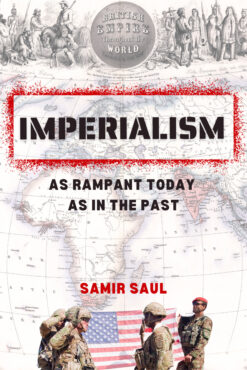
Imperialism

As Rampant Today as in the Past

New!

2024 is not 1914. Yet, while much has changed since the first world war, the global state of imperialism has not significantly altered. Unlike a hundred years ago, this is no longer a situation of relatively equal adversaries facing off against each other. Rather, we live in a world where one hegemonic power––the USA––is trying desperately by and all means to cling to its world-wide domination, exercising hegemony over all. No other country, including China and Russia, has either the will or the capacity to replace it. Herein lies the source of the major tensions and conflicts in the world today. Imperialism proposes a new interpretation of contemporary imperialism. Highlighting its historical continuity, Samir shows how crucial the past is to understanding what is happening today. Since the fall of the Soviet Bloc, the term “imperialism” has largely disappeared from public discourse, but reality is forcing it back

Contributors

Samir Saul

Samir Saul is a full professor of international history at the Université de Montréal. He has taught and supervised many graduate students for over three decades, with a concentration on modern France and the Arab world. He did his doctorate in history at the Université de Paris. Along with dozens of scholarly articles and as many on current world problems for a larger public, he has published two major studies entitled La France et l’Égypte de 1882 à 1914. Intérêts économiques et implications politiques (Paris, 1997) and Intérêts économiques français et décolonisation de l’Afrique du Nord (1945-1962) (Paris, 2016). He is also co-editor of Méditerranée, Moyen-Orient : deux siècles de relations internationales (Paris, 2003). This is his first book to appear in English.

Chapter Contributors Pages Year Price
In this preface, Saul examines imperialism as the use of extra-economic means for economic ends, a pattern spanning all eras rather than a single stage of capitalism.
11 $1.10
In this chapter, Saul traces the prehistory of imperialism, examining how early agricultural states from the Neolithic Era onward engaged in coercive extraction of resources from conquered lands.
6 $0.60
In this chapter, Saul traces the rise of maritime and commercial empires in the ancient Mediterranean, discussing Minoan Crete around 2700 BC, Mycenaean Greece, Phoenician trade, Carthage, and …
4 $0.40
In this chapter, Saul traces the Roman Empire from its 753 BC founding in Latium through its Mediterranean dominance by 130 BC, its collapse in 476, and the Byzantine successor’s fall in 1453.
6 $0.60
In this chapter, Saul traces imperial extraction from the Arab expansion in the seventh century through the medieval period.
8 $0.80
In this chapter, Saul traces how the appropriation of wealth and territory by force evolved across the fifteenth through twentieth centuries, with particular attention to mercantilist imperialism …
15 $1.50
In this chapter, Saul traces how Portugal and Spain reshaped global trade during the fifteenth and sixteenth centuries.
12 $1.20
In this chapter, Saul traces the shift of the global economic centre from the Mediterranean to the Atlantic coast between the sixteenth and eighteenth centuries, centring on the rise of the …
22 $2.20
In this chapter, Saul traces the unravelling of the mercantilist colonial system between 1776 and 1815. He examines how the American Revolution, Adam Smith’s free trade arguments, and the …
18 $1.80
In this chapter, Saul traces how Britain, between the 1810s and 1860s, replaced its mercantilist imperial system with industrial export-driven trade.
15 $1.50
In this chapter, Saul examines Britain’s free-trade imperialism between the 1830s and 1860s, tracing how the repeal of the Corn Laws in 1846 and the abolition of the Navigation Acts …
20 $2.00
In this chapter, Saul traces neomercantilist imperialism from 1870 to 1945, a phase in which the 1873 depression, protectionist tariffs, and the scramble for colonies reshaped global power.
42 $4.20
In this chapter, Saul traces three intellectual traditions—liberalism, underconsumptionism, and Marxism—that shaped the analysis of imperialism from the late eighteenth century to the …
47 $4.70
In this chapter, Saul examines the transformation of global imperialism from 1945 to 1973, tracing how decolonisation and the rise of American economic hegemony reshaped world power structures.
35 $3.50
In this chapter, Saul examines the United States’ structural position as a rentier power since the 1971 collapse of Bretton Woods, where foreign capital inflows sustain American consumption …
55 $5.50
In this chapter, Saul traces imperialism from its precapitalist roots through mercantilist colonialism to the present, framing contemporary geopolitics as a struggle between American financial …
14 $1.40
This "chapter" is a bibliography.
4 $0.40