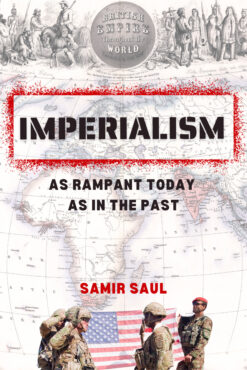
2024 is not 1914. Yet, while much has changed since the first world war, the global state of imperialism has not significantly altered. Unlike a hundred years ago, this is no longer a situation of relatively equal adversaries facing off against each other. Rather, we live in a world where one hegemonic power––the USA––is trying desperately by and all means to cling to its world-wide domination, exercising hegemony over all. No other country, including China and Russia, has either the will or the capacity to replace it. Herein lies the source of the major tensions and conflicts in the world today. Imperialism proposes a new interpretation of contemporary imperialism. Highlighting its historical continuity, Samir shows how crucial the past is to understanding what is happening today. Since the fall of the Soviet Bloc, the term “imperialism” has largely disappeared from public discourse, but reality is forcing it back
Contributors
Samir Saul
Samir Saul is a full professor of international history at the Université de Montréal. He has taught and supervised many graduate students for over three decades, with a concentration on modern France and the Arab world. He did his doctorate in history at the Université de Paris. Along with dozens of scholarly articles and as many on current world problems for a larger public, he has published two major studies entitled La France et l’Égypte de 1882 à 1914. Intérêts économiques et implications politiques (Paris, 1997) and Intérêts économiques français et décolonisation de l’Afrique du Nord (1945-1962) (Paris, 2016). He is also co-editor of Méditerranée, Moyen-Orient : deux siècles de relations internationales (Paris, 2003). This is his first book to appear in English.
Modal title
This project is funded in part by the Government of Canada. Ce projet est financé en partie par le gouvernement du Canada.