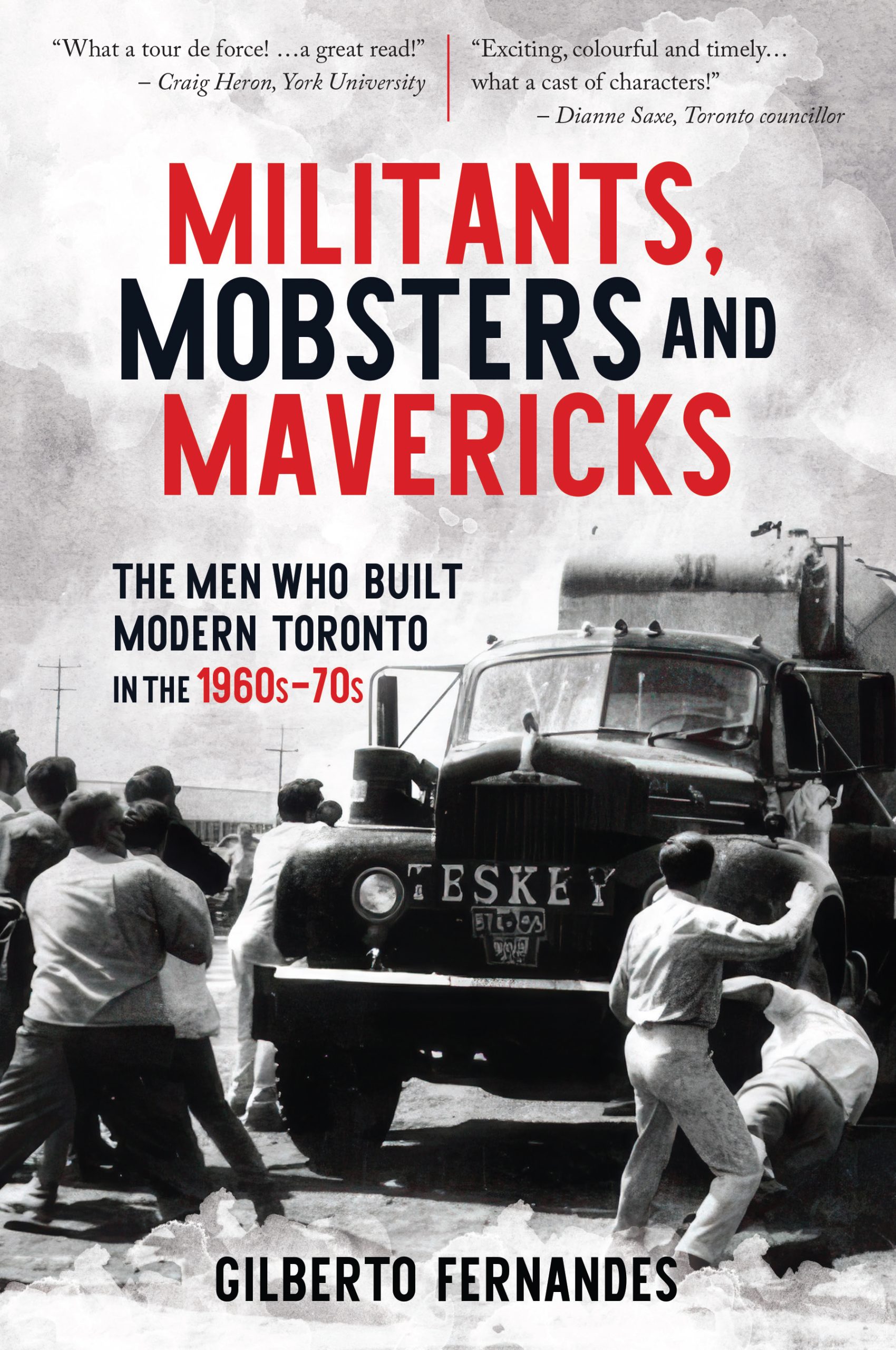
Militants, Mobsters and Mavericks

The Men Who Built Modern Toronto in the 1960s–70s

New!

This is a gripping look at the underbelly of Toronto’s explosive postwar growth in the 1960s and 1970s, at a time when labour leaders, politicians, contractors and crime figures battled for control of the city’s booming construction industry. Toronto’s highways, subways, and skyscrapers were built by immigrant workers under dangerous conditions, while they fought for fair wages and better safety measures.

Militants, Mobsters and Mavericks recounts the story of fiery union leader Gerry Gallagher and his cerebral successor Giovanni Stefanini. Along with them comes a remarkable cast of Toronto figures of the era, including journalist-turned-politician Frank Drea, idealistic coroner Morton Shulman, and Hamilton Mafia boss Johnny Papalia. Bombings at job sites, workplace safety disasters claiming the lives of Italian and Portuguese workers, police battles with defiant union members — Gilberto Fernandes’s gripping and action-packed narrative captures the fierce struggles of the era. This little-known history casts new light on the ongoing relations between provincial politicians and powerful construction unions, with their more than 75,000 Toronto-area members, today.

Contributors

Gilberto Fernandes

Gilberto Fernandes is a visiting scholar and instructor in the Department of History at York University. He is the author of several academic publications on the history of the Portuguese diaspora in North America, and Ontario's construction industry and building trade unions. He is an award-winning public historian with several credits, including documentaries, exhibitions, community archives, websites, podcasts, walking tours, and theatre. Among these are the award-winning project City Builders: A History of Immigrant Construction Workers in Postwar Toronto, as well as the Laborem Ex Machina: A History of Construction Machinery and Operating Engineers in Canada.

Chapter Contributors Pages Year Price
This prologue introduces the men and organizations that shaped Toronto’s building trades during the 1960s and 1970s. Fernandes recounts the Hogg’s Hollow tunnel fire of March 17, …
12 $1.20
This chapter traces the life of Gerry Gallagher, an Irish immigrant who arrived in Canada in 1951 to organize construction workers. It examines his wartime experiences, his founding of LIUNA …
15 $1.50
This chapter traces Gerry Gallagher’s union organizing across Ontario in the late 1940s and 1950s, particularly his recruitment of Hydro labourers for LIUNA Local 183, and discusses the …
11 $1.10
This chapter examines Toronto’s explosive postwar transformation from the late 1940s through the mid-1960s, when a million new residents reshaped the city. The narrative traces the housing …
12 $1.20
This chapter explores Toronto’s underground construction workers from the late 1940s through the 1970s. The chapter traces the deadly conditions faced by tunnellers building the Yonge and …
16 $1.60
This chapter traces the mid- to late- 1950s struggle of Italian-Canadian workers to organize in Toronto’s residential building trades. Through the stories of Bruno Zanini, Charles Irvine, …
8 $0.80
The Hogg’s Hollow tunnel disaster of March 17, 1960, in Toronto became a rallying point for exposing the exploitation of Italian immigrant construction workers. Frank Drea’s bold …
9 $0.90
This chapter traces the formation of the Brandon Union Group, a coalition of Italian-Canadian construction workers organizing for fair labour conditions in Toronto during the late 1950s and early …
13 $1.30
This chapter explores Toronto’s concrete transformation during the 1960s and 1970s, a period when immigrant workers and architectural innovation reshaped the city’s skyline.
13 $1.30
This chapter discuses the health toll of underground tunnelling, Italian immigrant labour organizing through Local 183, and organized crime’s encroachment on Toronto.
15 $1.50
This chapter discusses how the 1961 Toronto construction strike, led by Charles Irvine and Bruno Zanini, forced a fifty-day halt to residential construction after contractors abandoned union …
22 $2.20
This chapter examines the intersection of Italian-Canadian identity, union activism, and workplace safety in Toronto during 1961 and 1962. Fernandes explains how strikes, threats of violence …
17 $1.70
This chapter examines the 1962 collapse of Toronto’s Brandon Union Group and the tangled web of organized crime, labour politics, and public safety that unfolded across Canada in the early 1960s.
12 $1.20
This chapter offers a vivid portrait of John Gallagher’s construction safety campaign in Toronto, centred on Norm Pike, who led unannounced inspection blitzes that shut down over 350 unsafe …
12 $1.20
This chapter examines construction worker safety in Toronto during the mid-1960s. The narrative follows Local 183 leader Gerry Gallagher as he battled dangerous subway tunnelling conditions, …
18 $1.80
This chapter examines Toronto’s construction industry in the late 1960s. Fernandes traces how Local 183 workers—drawn from Irish, Italian, Portuguese, and Polish …
12 $1.20
This chapter offers a layered portrait of Toronto in the late 1960s, tracing its rise as Canada’s financial capital following Montreal’s gradual decline.
14 $1.40
This chapter traces the concrete forming industry in Toronto during the mid-to-late 1960s, centring on Nick Di Lorenzo’s struggle to maintain dominance as rival contractors challenged his grip.
11 $1.10
This chapter recounts the 1969 jurisdictional battle in Toronto between Local 183 carpenters and Local 562 lathers over nearly 2,500 formworkers in the residential concrete sector.
12 $1.20
This chapter examines the 1969–1971 leadership of Toronto’s concrete forming union, Local 183, as well as protests against Ontario’s Bill 167.
12 $1.20
This chapter traces the tangled web of organised crime, union conflicts, and political corruption within Toronto’s construction industry during the late 1960s and early 1970s.
12 $1.20
This chapter traces the autumn of 1971, when Local 183 business manager Stefanini secured agreements with five of Toronto’s largest high-rise apartment builders.
12 $1.20
This chapter traces the criminal violence and union racketeering that consumed Toronto’s construction industry in 1972 and 1973, including the bombings of Acme Lathing and the attempted …
13 $1.30
This chapter examines the transformation of labour relations inOntario’s construction industry during the early 1970s, centring on Local 183’s business manager Stefanini and his …
13 $1.30
This chapter examines how John Stefanini reshaped Local 183, a construction labourers’ union, during the mid-1970s.
14 $1.40
This chapter traces the life and legacy of Gerry Gallagher, an Irish-born construction union leader who died in 1978, and the turbulent world of Toronto building trades that followed.
13 $1.30
This chapter traces the career of John Stefanini, the Italian-Canadian leader who built LIUNA Local 183 into North America’s largest construction union during the 1980s and early 1990s.
18 $1.80
This chapter traces the evolution of Toronto’s Local 183 construction union from the 1960s through 2025, examining how figures like Gerry Gallagher, Charlie Irvine, and John Stefanini …
18 $1.80
This "chapter" includes endnotes and visual credits
22 $2.20