
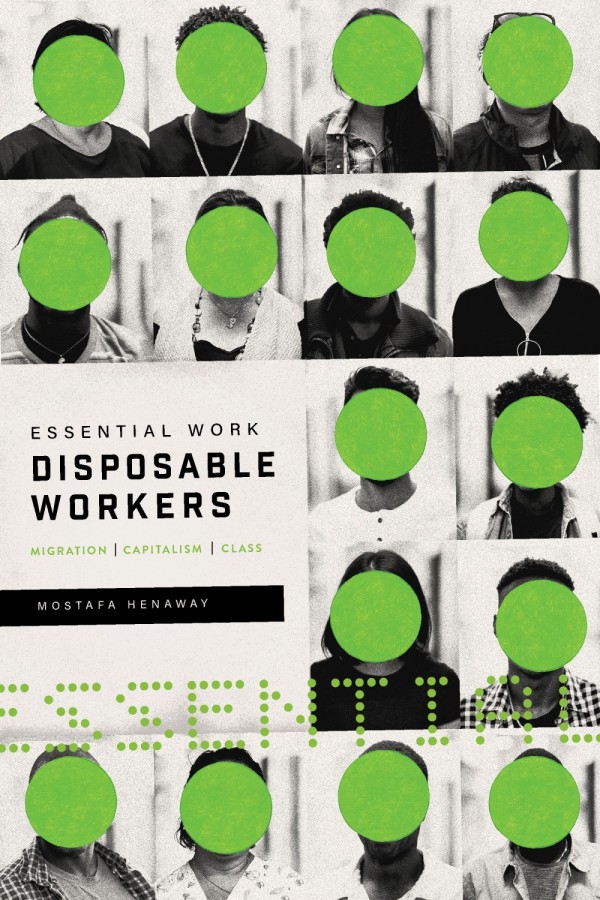
Essential Work Disposable Workers

Migration, Capitalism, and Class

Across the world we are witnessing daily the lethal effects of a rapid and scary hardening of borders, ignited and justified by manufactured fear and scarcity. In such conditions, highly exploitative ideas of “managed migration” are presented as reasonable and just.

And temporary worker programs, championed by countries like Canada and the US, are presented as an acceptable response to both acute labour shortages and ugly nationalist feelings. For this, all workers pay the price in the form of dwindling rights and diminished solidarity. This book is the result of decades of thinking, organizing and deep research on the global struggle for equality and freedom in and against an increasingly walled world. Through this immediate and up-close account, Henaway takes the reader on a journey across a familiar consumer landscape of corporate power — from Amazon and Dollarama to chicken farms and late night rideshares —offering a vivid analysis of the consequences of a system built to marginalize, exploit and divide people through the creation of exclusionary categories of belonging.

In Essential Work, Disposable Workers, Henaway offers a counter proposal to the global border, arguing that we reject control over freedom of movement as a means to halt a race to the bottom for all working people and instead build solidarity across struggles for decent work and justice. In this moving account of a global system of hyper-exploitation, Henaway weaves stories of struggle with his own on-the-ground experience and expansive research, to explain the workings of a global system of managed precarity that affects everyone who works, albeit unequally. Written with the unique verve and insight of a committed scholar and decades-long grassroots organizer, Essential Work, Disposable Workers offers a vivid analysis to help us grasp the cruel consequences of borders and points to an alternative future.

Contributors

Mostafa Henaway

Mostafa Henaway, a Canadian-born Egyptian, is a long-time community organizer at the Immigrant Workers Centre in Montreal, where he has been organizing for justice for immigrant/migrant workers for over two decades. He is also a researcher and PhD candidate at Concordia University


Chapter Contributors Pages Year Price
This section includes the foreword and introduction of this book. In the introduction, Mostafa Heneway describes the political landscape that facilitates the exploitation of migrant workers and …
14 $1.40
This chapter focuses on four countries in the Global South to illustrate how the implementation of neoliberal policies has not led to development but has turned them into major labour-exporting …
15 $1.50
This chapter examines how remittances play a crucial role within global capitalism. Remittances reinforce a pattern of migration from the Global South to the North, increasingly necessary for …
9 $0.90
Borders have become a means through which states can dispose of unwanted migrants through deportation and award those deemed legitimate with permanent residency. This has led to the increased …
10 $1.00
This chapter examines how, since 2006, Canada has constructed an immigration regime that centres temporary migrant labour — the ideal immigration regime in service of global capitalism. Canada’s …
13 $1.30
This chapter specifically follows the rise of temporary placement agencies as a tool of employers to utilize undocumented, precarious and racialized migrants for capital. The shift from …
12 $1.20
This chapter demonstrates the growing size and power of the food industry in the global economy across its supply chains. Capital-intensive farming, food-processing and major food retailers and …
17 $1.70
This chapter focuses on how the rise of just-in-time distribution, a sector of growing importance to global capitalism, has been fuelled with the rise of just-in-time employment — meaning a …
11 $1.10
This chapter is a small love note to the iwc (Immigrant Workers Centre) for always being willing to experiment to find new ways to build leadership and solidarity. It’s difficult for unions to …
10 $1.00
This chapter describes how worker centres emerged as a new model of organizing migrant workers in response to the sweeping global economic transformations of neoliberalism, described in the first …
19 $1.90
This chapter illustrates how new unions and worker centres emerged to successfully organize in global cities like Toronto, New York and London and within the chokepoints of logistics hubs for …
14 $1.40
This chapter is about how migrant and racialized worker organizations took leadership in broad-based campaigns to improve conditions for the entire working class. As one example, the chapter …
12 $1.20
This chapter describes why undocumented migrants’ struggles for status are fundamentally about workers’ rights. In certain moments, like 2006 and 2017 in the US and 2008 in France, marginalized …
10 $1.00
This chapter is an effort to convey the urgency of permanent status for migrants. The chapter examines the campaigns of self-organized migrants who have constructed communities of struggle that …
16 $1.60
In the conclusion to this book, Heneway discusses capitalism as an economic system, and once again breaks down the impact of globalization on trade and labour.
10 $1.00